


Squirrel Removal
Squirrel Trapping
Squirrel Damage Repair
Squirrel Exclusion
Serving Owosso, Corunna, East Lansing, Okemos, Bath, St. Johns, Chesaning, Flushing, Swartz Creek, Bancroft, Williamston, DeWitt, Durand, Ovid, Perry, and Laingsburg
We will humanely trap and remove squirrels from your premises. Holes will then be sealed and damages repaired to ensure that new squirrels do not move in.
Call today to schedule an inspection.
(989) 472-1333
Write your title here. Click to edit.
Squirrels are members of the order Rodentia, making them cousins of rats, mice, woodchucks, and beavers. Like all rodents, they have a set of incisor teeth that never stop growing and are reinforced with iron. These specialized teeth encourage and require squirrels to continuously be chewing something. This is generally not a problem when they are working their way through the husk of a walnut, but when they turn these biological tools against your home, things change.
Like all home-invading animals, they will gladly use openings that have been left behind by builders. However, due to their dental specialization, they can often just create their own personal doorway into your home.
When squirrels move into a house, the first thing people usually notice is the noise. Chewing, running, and scratching noises coming from the attic or eves are generally what occupants report hearing. Sometimes it even sounds like there is a bowling ball rolling across the ceiling.
An adult female squirrel will usually have two litters of pups every year. One in the spring, and another in the fall. The litters generally contain 2-4 pups, but I have found up to eight in one nest after a very productive year for acorns. Once these juveniles are mobile, the amount of noise drastically increases.
Aside from the noise, the main issue with having squirrels in your attic is their propensity to chew. Although rare, house fires have been started by rodents gnawing on electrical wires.
Squirrels in the attic is a year-round problem, but the seasons do affect activity. They tend to get quite noisy in the spring and fall until the pups are large enough to leave. In the fall, they are also busy bringing food inside to add to their winter hordes. Squirrels can store up to three seasons worth of food in your attic and walls. The summer tends to be the quietest time for squirrels as they spend most of their time outside, enjoying the pleasant temperatures. The winter cold however encourages them to spend more time indoors, living off of their stored food.
Whatever the season, removing squirrels from homes is one of our specialties. It can be tricky to figure out where they are coming in from and even more difficult to keep them from coming back once they are gone. Let us do the hard work for you and schedule an inspection today.

ENTRY POINTS
Squirrels are intelligent and persistent animals that possess the ability to chew holes into most home construction materials.
They often enter homes through vents or gaps between the soffit and shingles on the roof.
We will thoroughly inspect your home to determine exactly where they are getting in. Once the squirrels have been dealt with, we close their entry points and secure common entry areas against future access.
REMOVAL
After identifying the entry points, we will set traps at these locations to capture and remove the animals. By removing the squirrels from the premises, we reduce the risk of new holes being created by squirrels who know the building as home.
We use a combination of live and lethal trapping methods for best results.

Contact us today to set up an estimate.
TYPES OF SQUIRRELS

RED SQUIRREL
Red squirrels are our most common target squirrel. These small, noisy animals will often be heard running around in attics and climbing up and down inside of walls.
Red squirrels can be easily identified by their small size. They have a red to gray colored back and tail, with a white belly.
FOX SQUIRREL
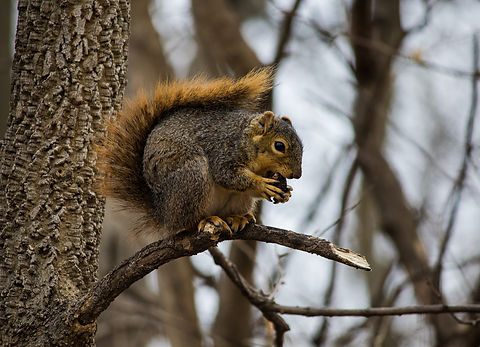
Although you are most likely to see a fox squirrel running around your yard, they are also the least likely to be the cause of attic activity. We do find some instances of fox squirrels entering homes, but we usually end up removing them from a location simply to keep them from interfering with trapping efforts.
Fox squirrels are the largest species of squirrel in Michigan. Their backs are grey to brown with orange tails and bellies.

GRAY SQUIRREL
Gray squirrels are less common than their larger fox squirrel cousins in most areas of Michigan. The gray squirrel is actually an international nuisance pest and has become invasive in many places around the world.
Gray squirrels can be most easily identified by their silver gray coloring, although they sometimes will have more of a brownish color when they are young.
BLACK SQUIRREL
In Michigan, there is no species of black squirrel. Instead, the black squirrels that can be observed in many areas are actually gray or fox squirrels with a genetic mutation that causes an overproduction of melanin.
Black squirrels can sometimes be seen with white patches randomly in their fur or with orange tails.


FLYING SQUIRREL
Flying squirrels are the most inconspicuous species of squirrel in Michigan. Being small and nocturnal, they very often go unnoticed while outdoors. However, they can become quite noisy in your attic.
Flying squirrels are colonial, meaning that they like to live together in groups of up to 20 individuals.
These animals can be identified by their silver coloring and large dark eyes. They can also be seen "flying," which is quite distinctive. Flying squirrels are often confused with sugar gliders, which are completely unrelated but sometimes kept as pets.
CHIPMUNK
Chipmunks are the smallest of the squirrels listed here. These are burrowing animals that prefer to spend their time on and under the ground. They will however enter basements if they find an opening.
Chipmunks are often confused with red squirrels but can be differentiated by the black stripes on their back and the short, skinny tail.

Contact us today to set up an inspection.
